Benedictus
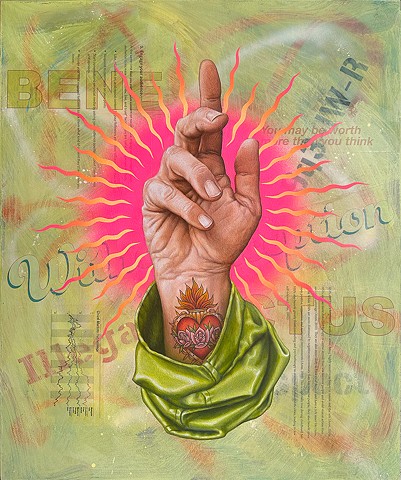
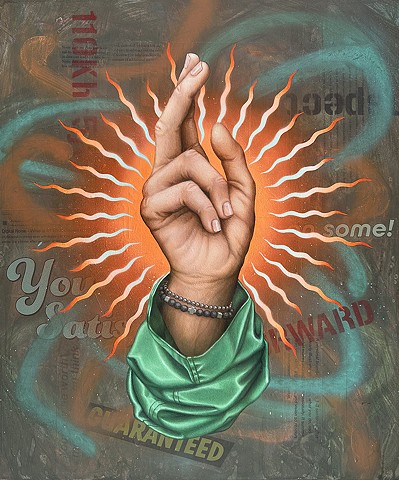
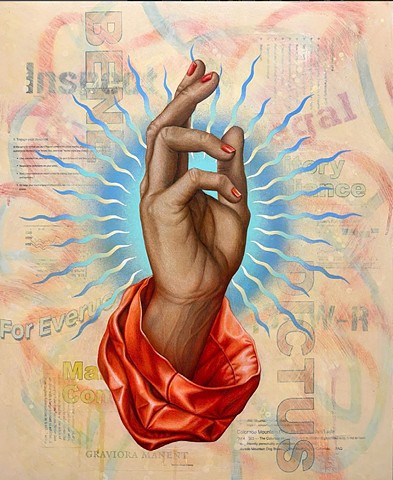
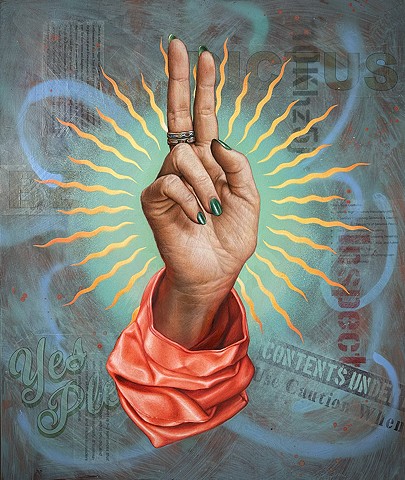
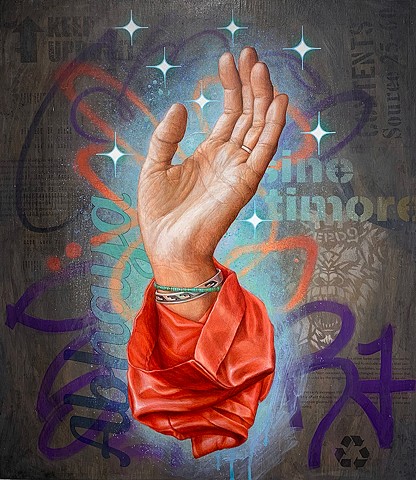
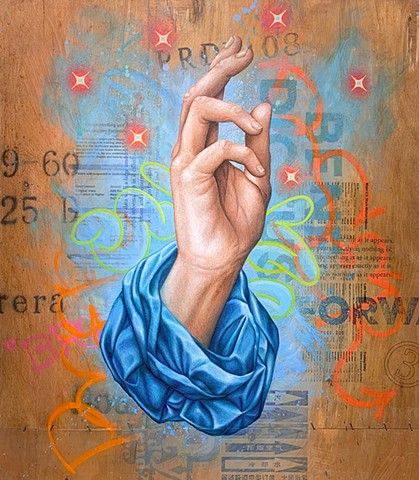
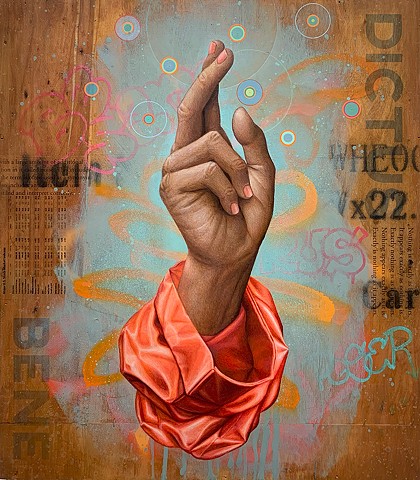
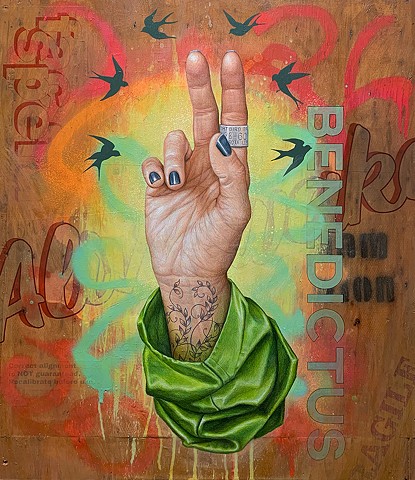
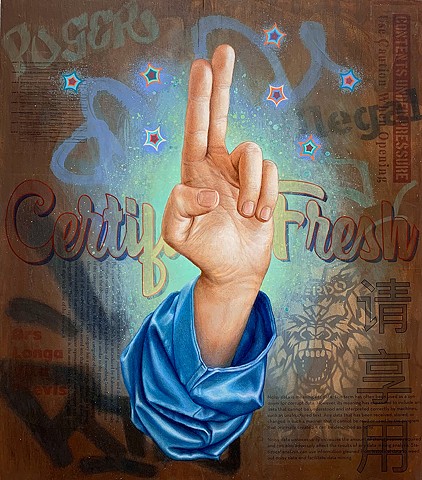
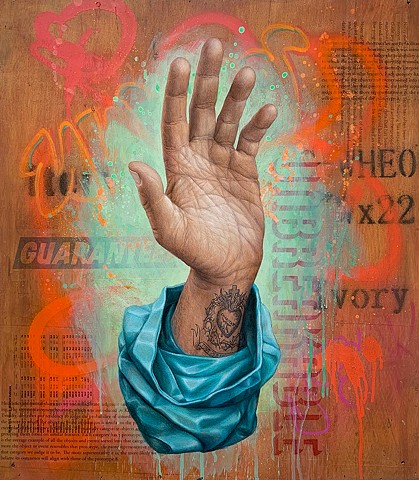
During the Covid pandemic, I became restless to shake up my creative process by introducing an element of chance. To that end, I placed reclaimed plywood panels in anonymous public spaces around the city that were likely to accumulate graffiti. These panels had the word “illegal” stenciled on them, in hopes that they would provoke interaction from graffiti taggers. After a while I collected the panels, took them back to my studio and added other text and images over them. Each painting became a “palimpsest” - a surface that has been reused or altered, but still bears visible traces of its earlier form. The final layer of each image is a careful rendering of a hand posed in a sign of blessing. The hands depict a variety of ethnicities, gender and age. In this group of paintings I wanted to blur the lines between “fine art” and street art, and the sacred and profane, and to illuminate the idea that ordinary people should be a be a blessing to each other.
A note about the hand poses:
This symbolic gesture of benediction first appears in ancient Greek art and statuary. It was thought to be a sign made by an orator or public leader during a speech as a symbol of wisdom and authority, not as a sign of blessing. A modified version was used by early Christians as a sign of affiliation with one another. In this version, the index and pinky finger are curved to mimic Greek letter X in an abbreviated spelling of the name Jesus Christ. Over time, the Christian church adopted a more relaxed gesture, closer in pose to the earlier Greek version, as a sign of “benediction.” The word benediction comes from Latin dictus (to speak) and bene (well, or good). Literally, to speak well on behalf of another.
Similar, but unrelated symbolic gestures can be found in the Hindu and Buddhist practice of Mudras - ritualized hand gestures - first used in art and dance, to teach specific spiritual lessons. Like other ritualized hand gestures, the use of mudras has evolved over centuries. Mudras are now commonly used in many yoga practices and are thought to aid in the direction of energies during meditation.